Food Labels – what does it all mean?
I was heartened to read in more than one place that no fresh vegetables, fruit or meat sold in New Zealand are genetically modified and hopefully it will stay that way. However, that doesn’t include medicines, vaccines, processed food or imported ingredients. Freshest foods are best, so shop local and in season so you are getting the most nutritional bang for your buck. Other tricks are to shop organic, grow your own or eat from the outer aisles of the supermarkets to stay away from processed foods. Below are some of the labels we encounter and what they mean…
How food is grown
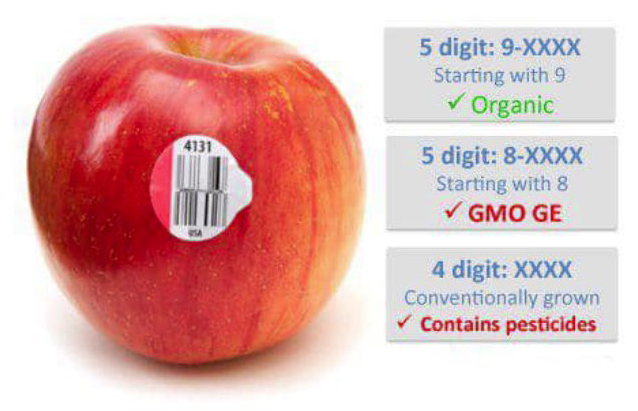
4 Digit Code – starting with 3 or 4 is Conventionally Grown – can be grown with the help of synthetic fertilisers and pesticides to combat potential diseases and boost growth. Wash thoroughly before eating – food washing tips here.
5 digit code – starting with 9 is Organic (Biogro and AsureQuality NZ brands). Grown with natural fertilisers, such as manure or compost, and relies on natural biological or mechanical weed control. Its soil must have been free of prohibited products for three years before gaining organic certification from the United States Department of Agriculture. All organic items are non-GMO.
5 digit code – starting with 8 is Genetically Modified. At a glance, you can see whether a food product contains any GM-derived ingredients because they must be stated in the ingredient list. This includes any food additive, processing aid or flavouring that contains modified DNA or protein, or any food having altered characteristics as a result of GM (for example, soybeans with high oleic acid content). Foods served in a restaurant or cafe, or from a takeaway are exempt from these labelling requirements. If you need to know more, ask the staff. Products that unintentionally contain GM material at less than 1% don’t have to have a GM label, although food businesses are required to take all reasonable steps to avoid this happening. Flavourings that make up less than 0.1% of a food are also exempt.
Spray Free – These products that are grown organically, but have not been certified as such, due to cost of certification to the grower, or no certifying body in the country of origin. Spray-Free means no synthetic chemical sprays (pesticides/herbicides) are used on the crops during cultivation. While synthetic sprays have not been used, it is important to note that some local farmers may still use synthetic fertilisers.
Dates/shelf life
Use-by date – A use-by label relates to food safety. If it’s past its use-by, say “goodbye” – eating this food could make you sick. Foods with use-by dates can become unsafe to eat before they are visibly spoiled or off. It’s illegal to sell food past its use-by date.
Best-before date – A best-before label relates to the food’s quality. If it looks and smells okay, it probably is. Check it, sniff it, taste it – don’t waste it. Foods with best-before dates will spoil before they become unsafe to eat. Food can be sold beyond its best-before date, as long as it’s still safe to eat.
Baked-on or baked-for – found on bread products with a shelf life of fewer than 7 days.
Ingredients
The ingredient list shows any ingredient in the food, including added water, food additives and compound ingredients (ingredients that are themselves made up of 2 or more ingredients, such as chocolate chips or icing). Ingredients are listed in order of quantity present in the product, so the first food listed will be the major ingredient. If sugar or fat is listed in the first two or three ingredients then this food is most likely not a healthy choice.
Nutrition Panel – The 7 key nutrient components of food are listed in the Nutrition Information Panel (NIP). This helps you compare products for the overall energy (kilojoules or calories), the level of saturated fat, sugar, and sodium, among others. Some food packages don’t require a Nutrition Information Panel, for example, if they are very small (like chewing gum) or have minimal nutrition (like herbs, spices, herbal infusions, tea or coffee, vinegar, salt, water or jam setting compounds). Alcoholic beverages (including kits for producing them) also don’t require a Nutrition Information Panel. A Nutrition Information Panel is also required when there are nutrition content claims or health claims made about the product. For example, if there is a claim about the calcium content of a food, the Nutrition Information Panel must also show the level of calcium present.
Food Additives – The 3-digit codes in the ingredient list are unique international identification numbers for food additives. Food additives are natural or synthetic chemicals added during manufacture to extend the product’s shelf life, or make the product more appealing. The code numbers save space and avoid confusion over similar names. Food additives are listed according to their function and name or code, for example, ‘Thickener (pectin)’ or ‘Thickener (440)’. If you need to know more about a specific food additive (such as whether it’s derived from plant or animal origin), contact the manufacturer.
Allergen declarations (allergy labels) – Because allergies to certain food proteins (allergens) can be life threatening, the most common food allergens (such as nuts, dairy products, eggs, gluten and soy) must be declared on a food label, or information about them should be available at the point of sale. Allergens must be declared if they are added as an ingredient, part of a compound ingredient, an additive, a processing aid or component of these.
E numbers – Europe, NZ and Australia use E numbers to accurately describe additives. See full list and where they are used here.
- E100s: generally food colours.
- E200s: mainly preservatives and acids.
- E300s: mainly antioxidants and acid regulators.
- E400s: include emulsifiers, stabilisers, and thickeners.
- E500s: include anti-caking agents and acidity regulators.
- E600s: mainly flavour enhancers.
- E900s: include sweeteners, glazing agents, foaming agents, and gases.
- E1000s: other additives.
Foreign Food
Country of origin labelling is voluntary in New Zealand, except for wine. Suppliers (usually manufacturers, transporters, or sellers) may choose not to display the country of origin. A wine label must include a statement indicating the country of origin.
Irradiated food – Food treated with ionising radiation to kill unwanted pests and micro-organisms is known as irradiated food. Some tropical fruits and tomatoes imported from Queensland may be irradiated, as are some imported herbs and spices and herbal infusions (excluding tea). Fruits and vegetables that may be irradiated include apple, apricot, breadfruit, capsicum, carambola (star fruit) cherry, custard apple, honeydew, litchi (lychee), longan, mango, mangosteen, nectarine, papaya, (paw paw), peach, persimmon, plum, rambutan, rockmelon, scallopini, strawberry, table grape, tomato and zucchini (courgette). These must be clearly labelled as irradiated. When a full label is not required, this information must be displayed on or close to the food at all points of sale.
Apeel/Edipeel/Invisipeel – Bill Gates latest venture, Apeel Sciences has developed a tasteless, odourless and colourless coating for fruit & vegetables to prolong the life of the food. Apeel Sciences makes their products from monoglycerides and diglycerides, which are naturally-occuring in pulps, peels, seeds and stems of all fruits and vegetables. The label commonly seen will be Apeel, but also owns brands called Invisipeel and Edipeel.
Invisipeel, can be applied by growers to crops in the field. Growers can also apply Edipeel after harvest. With Edipeel, the growers wait until crops are ripe before harvesting them and then place them on conveyor belts to spray or simply dip them into the Apeel solution, which solidifies around the fruit or vegetable, forming a barrier.
Apeel’s Edipeel is allowed for use on fruits and vegetables in the United States, Canada, Chile, China, Colombia, Japan, Kenya, Mexico, Peru, and South Africa, without restriction. Additionally, Edipeel is allowed for use on the following fruits in the European Union, Norway, Switzerland, and the United Kingdom: avocados, citrus fruit, mangoes, papayas, melons, bananas, pineapples, and pomegranates.
Apeel Sciences provides specifications for monoglyceride (≥ 91%) and diglyceride (≤ 7%) levels as well as limits for ethyl acetate (≤ 100 milligrams per kilogram (mg/kg)), acetonitrile (≤ 5 mg/kg), toluene (≤ 5 mg/kg), hexane (≤ 25 mg/kg), and individual heavy metals (including Lead (≤ 1 mg/kg), Palladium (≤ 3 mg/kg) and Arsenic (≤ 0.2 mg/kg)), in the finished product.
Information about the chemical process used to extract the lipids and the types of fruit and vegetables used and the solidification process is here.
Novel Food (Insects)
A new arena of food is being introduced to Western diets directly as flour and in processed foods and indirectly (through fish and animal feed). The addition of insects is usually prominently advertised on the packaging as well; after all, edible insects are still niche products and relatively expensive. If you do not want to participate, start familiarising yourself with food labels. A large number of applications for approval have been submitted to the European Commission. So far, the following insects are officially approved:
- Yellow Mealworm (Tenebrio molitor)– frozen, dried or powdered larvae of the flour beetle (since May 2021)
- Migratory locust (Locusta migratoria) – frozen, dried or powdered. (since November 2021)
- House cricket (Acheta domesticus) – frozen, dried, powdered (since March 2022) and partially defatted powder (since January 2023)
- Tropical house cricket (Gryllodes sigillatus)
- Buffalo worm/Lesser Mealworm/Litter beetle (Alphitobius diaperinus) – frozen, paste, dried or powdered larvae of the grain mold beetle (since January 2023)
The following processed foods are produced in North America (including Canada), and the EU:
- Insect flour: Pulverized, freeze-dried insects (e.g., cricket flour).
- Insect burger: Hamburger patties made from insect powder / insect flour (mainly from mealworms or from house cricket) and other ingredients.
- Insect fitness bars: Protein bars containing insect powder (mostly house crickets).
- Insect pasta: Pasta made of wheat flour, fortified with insect flour (house crickets or mealworms).
- Insect bread (Finnish Sirkkaleipä): Bread baked with insect flour (mostly house crickets).
- Insect snacks: Crisps, flips or small snacks (bites) made with insect powder and other ingredients.
Food and drink companies such as the Australian brewery Bentspoke Brewing Co and the South African startup Gourmet Grubb have introduced insect-based beer, a milk alternative, and insect ice cream.
https://en.wikipedia.org/wiki/Insects_as_food
Links
https://dermnetnz.org/topics/food-additives-and-e-numbers
https://www.foodstandards.gov.au
https://www.mpi.govt.nz/food-safety-home/how-read-food-labels/
https://www.eatingwell.com/article/7677635/what-those-codes-on-your-produce-really-mean/
https://ec.europa.eu/food/food-feed-portal/screen/novel-food-catalogue/search